
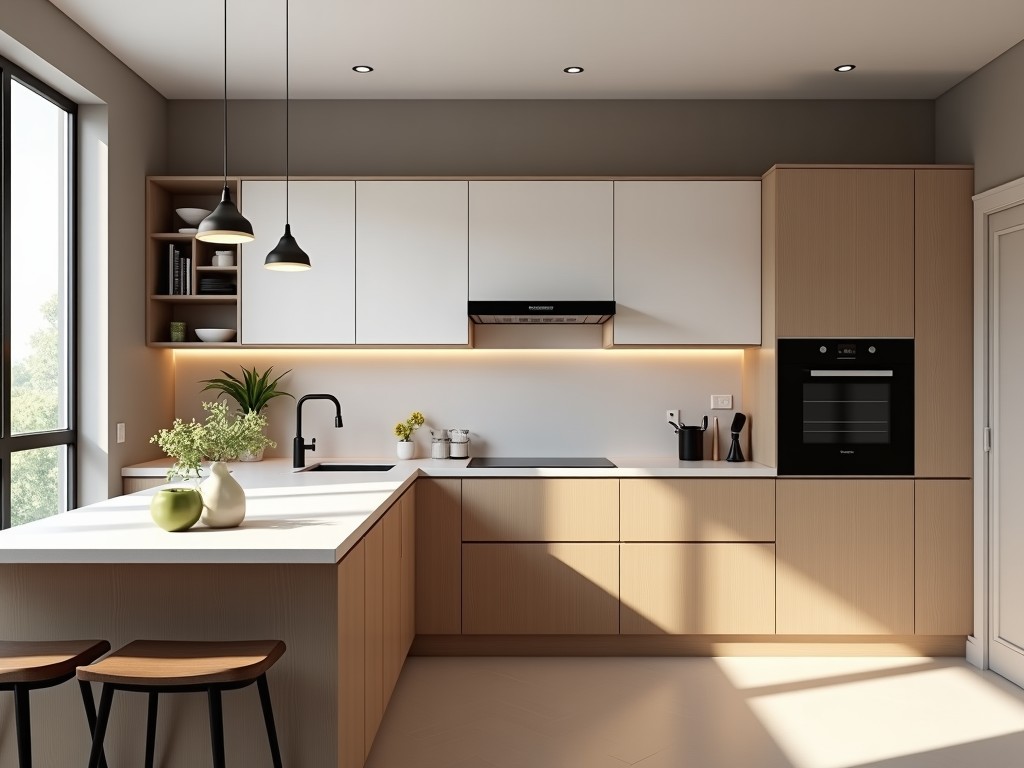
Oem Custom Kitchen Cabinets Cost Price
Inquire Now
OEM Custom Kitchen Cabinets: Cost, Price Factors, and Specification Guide
Understanding Cost Drivers in Custom Cabinetry
The total price of an OEM kitchen cabinet reflects several quantifiable inputs: raw material cost per sheet, hardware unit price, finish consumption, machining time, and labor overhead. Volume influences unit cost because fixed setup expenses are amortized over more pieces, while low‑volume runs incur higher per‑item overhead.
Material Selection and Impact on Price
Sheet goods vary widely in density, moisture stability, and surface preparation needs, which directly affect both material price and processing time.
- Particleboard with melamine laminate – lowest material cost, high screw‑holding strength, requires edge banding.
- MDF – uniform density, excellent for painted finishes, slightly higher material cost, generates more dust during routing.
- Hardwood plywood (birch, maple) – superior dimensional stability, premium material cost, accepts veneer or clear coat.
- Solid wood strips (oak, walnut) – highest material cost, natural movement considerations, used for face frames or accent panels.
Manufacturing Processes and Lead Time Influence
CNC nesting reduces sheet waste and improves repeatability; typical cycle time for a standard base cabinet is 12‑18 minutes per unit, including drilling, routing, and edge banding. Lead time extends when custom finishes require multiple spray coats or when specialized hardware (soft‑close hinges, pull‑out systems) must be sourced.
Customization Options and Associated Cost Implications
Each design variable adds a measurable cost increment that can be estimated during quoting.
- Non‑standard width or height – +$8‑$15 per linear foot for additional cutting and programming.
- Shaker, slab, or raised‑panel door styles – door‑style surcharge ranges from $12‑$30 per door based on profile complexity.
- Premium hardware (blum soft‑close, magnetic catches) – +$2‑$5 per unit.
- Interior accessories (pull‑out trays, lazy Susans) – +$18‑$45 per accessory.
- Custom finish (glaze, distressed, UV‑cured) – +$5‑$12 per square foot of surface area.
Typical Price Ranges
| Material | Finish Type | Price per Linear Foot (USD) |
|---|---|---|
| Particleboard + Melamine | Standard Laminate | $45 – $60 |
| MDF | Painted (2‑coat) | $55 – $75 |
| Hardwood Plywood | Veneer + Clear Coat | $70 – $95 |
| Solid Wood (Face Frame) | Stained + Topcoat | $90 – $130 |
Values are typical for mid‑volume production (50‑200 linear feet); exact quotes vary with project‑specific tolerances, hardware selections, and finish layers.
Quality Control and Tolerance Standards
Dimensional accuracy is maintained to ±0.5 mm on panel cuts and ±1.0 mm on overall cabinet width. Joint strength is verified using pull‑test standards (≥150 N for cam‑lock assemblies). Finish adhesion is assessed via cross‑hatch testing (ASTM D3359) with a target rating of 4B or better before packaging.
Applications in Commercial and Residential Projects
OEM‑spec cabinets suit multi‑family developments where repeatable layouts reduce on‑site installation time, hospitality environments requiring durable finishes that withstand frequent cleaning, and high‑end residential builds where designers demand precise dimensional matching to architectural millwork. The ability to match exact panel thicknesses and reveal gaps minimizes field adjustments and associated labor costs.
Getting an Accurate Quote: Information Required
Providing the following data enables a precise cost model and reduces quotation cycles.
- Cabinet layout drawings (plan and elevation) with clear opening dimensions.
- Material preferences for boxes, doors, and face frames.
- Finish specifications (color codes, gloss level, coat count).
- Hardware list or preferred brands for hinges, slides, and pulls.
- Required accessories (pull‑out shelves, wine racks, lighting).
- Quantity per style and total linear footage.
- Desired delivery schedule and any site‑specific restrictions (elevator size, stairwell width).
Frequently Asked Questions
Can dimensions be customized beyond standard increments?
Yes. CNC programming allows any width or height within material sheet limits; non‑standard sizes incur a modest programming and cutting surcharge.
What information is needed before a quotation can be issued?
Layout drawings, material and finish selections, hardware choices, accessory list, quantities, and delivery timeline are essential for an accurate estimate.
Which materials are available for interior shelving?
Options include matching plywood, MDF with edge banding, or particleboard with melamine; each carries a different cost and load‑rating profile.
How is quality inspected before shipment?
Each batch undergoes dimensional verification, joint strength testing, and finish adhesion checks; only units meeting the defined tolerances are cleared for packing.
What packaging methods protect cabinets during transit?
Flat‑packed panels are separated by corrugated dividers, corner protectors are applied, and units are secured on pallets with stretch film; optional foam edging is available for high‑gloss finishes.
What is the typical production lead time?
For standard material grades and finishes, lead time ranges from 3‑4 weeks after drawing approval; custom finishes or specialty hardware may extend this to 5‑6 weeks.
How are samples arranged for finish validation?
Finish samples (150 mm × 150 mm panels) can be shipped via courier; charges are credited against the first production order upon approval.
Request a Detailed QuoteRelated Products
Related News

custom closet spatial organization and material performance analysis

Bathroom Taps Technical Analysis
