
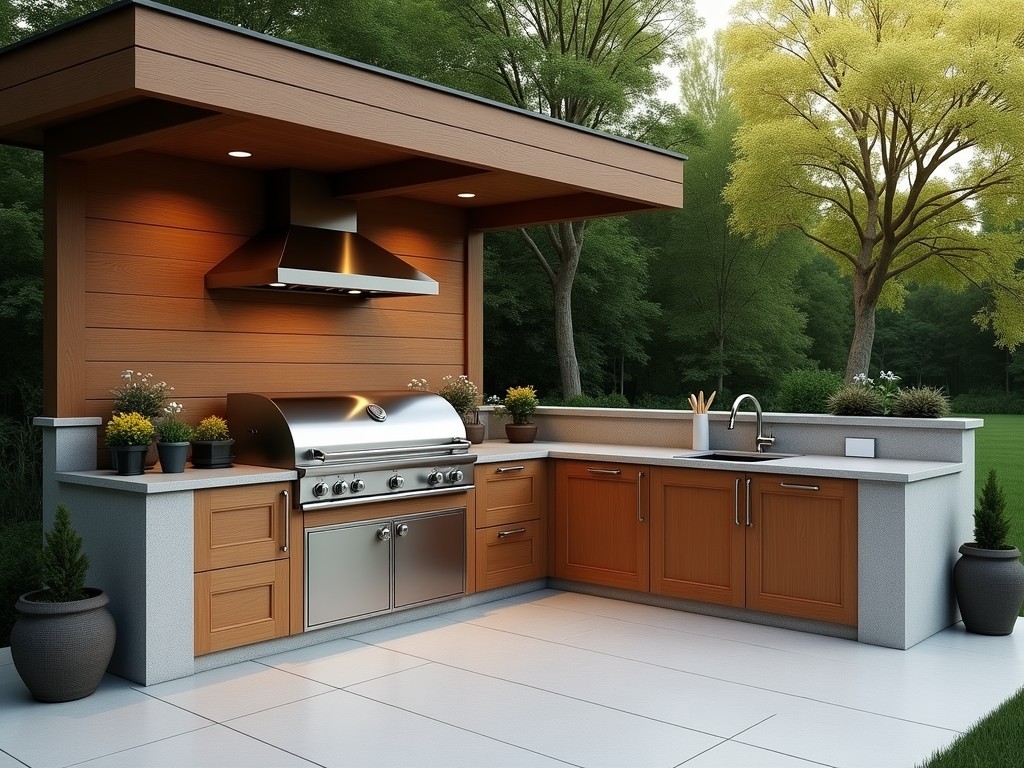
Oem Custom Outdoor Kitchen Cabinets
Inquire Now
OEM Custom Outdoor Kitchen Cabinets
OEM custom outdoor kitchen cabinets are fabricated to the exact specifications of equipment manufacturers who integrate storage, prep, and service units into exterior cooking environments. They must withstand temperature swings, UV exposure, moisture, and mechanical loads while maintaining dimensional stability.
Functional Requirements
Functional requirements begin with load capacity. Cabinets often support countertop appliances weighing up to 150 kg, so structural members are sized to resist bending and shear. Corrosion resistance is measured by salt‑spray endurance (ASTM B117) with a target of 1000 hours for exposed aluminum or stainless steel. UV stability is quantified by retention of tensile strength after 1500 hours of UV‑A/B exposure per ASTM G154.
Material Options
Materials are chosen based on the balance of mechanical strength, weight, and environmental resistance. Marine‑grade polymer composites (e.g., fiberglass‑reinforced polypropylene) provide densities around 1.1 g/cm³ and are inherently corrosion‑free. Powder‑coated aluminum alloys (6063‑T5) offer a density of 2.7 g/cm³ and achieve 1200 hours salt‑spray resistance when coated with a 60 µm polyester powder. Stainless steel grade 316 provides a density of 8.0 g/cm³ and exceeds 2000 hours salt‑spray resistance. Treated hardwoods (e.g., teak) are limited to interior shelving where direct water contact is minimized.
Customization Choices
Dimensional customization is achieved through CNC routing with tolerances of ±0.5 mm on panel edges and ±1.0 mm on overall cabinet depth. Mounting systems include adjustable stainless steel brackets that accommodate wall thickness variations of 20‑50 mm. Interior accessories such as pull‑out drawers, towel bars, and spice racks are supplied as separate modules with standardized 32 mm hole patterns for hardware integration. Finish options range from matte powder coating in RAL colors to brushed stainless steel or UV‑stable gelcoat surfaces.
Design Considerations
Drainage channels are incorporated into the base frame to direct water away from joints, with a minimum slope of 2 mm per 100 mm. Ventilation gaps of 5 mm are provided behind panels to allow air circulation and reduce condensation. Thermal expansion coefficients are accounted for by providing expansion joints of 3 mm at every 1 meter of linear length. Seam sealing uses marine‑grade silicone with a Shore A hardness of 35 to maintain flexibility after curing.
Manufacturing Process
Production starts with CNC cutting of panels to nominal size, followed by edge banding with PVC or aluminum tape to protect cut edges. For metal cabinets, panels are bent using press brakes with a radius of 2 mm to avoid stress concentrations. Welding of stainless steel frames employs TIG with argon shielding to achieve penetration depth of 1.2 mm. Powder coating is applied in a climate‑controlled booth, cured at 180 °C for 20 minutes, and inspected for film thickness using a dry‑film gauge (target 60‑80 µm). Final assembly includes insertion of hardware, torque‑controlled fastening to 5 Nm for bolts, and a functional check of door alignment.
Quality Control
Dimensional verification is performed on a coordinate measuring machine (CMM) with a repeatability of ±0.02 mm. Salt‑spray testing follows ASTM B117 for 1000 hours, after which visual inspection checks for blistering or rust. UV exposure testing uses a QUV apparatus for 1500 hours, measuring color change (ΔE) under CIELAB; acceptable ΔE < 3. Load testing applies a uniform distributed load of 2.0 kN/m² to the cabinet top for 24 hours, recording deflection; permissible deflection is L/200 where L is span length. Each batch receives a traceability label with lot number, material grade, and inspection date.
Applications
Outdoor kitchen cabinets serve residential patio installations where they integrate with built‑in grills, side burners, and under‑counter refrigerators. In commercial hospitality settings, they support high‑volume service lines, requiring resistance to frequent cleaning agents and heavy‑use impacts. Marine applications, such as yacht galleys, benefit from salt‑resistant materials and minimal maintenance. The modular design allows OEMs to configure cabinets for linear islands, L‑shapes, or U‑shapes while maintaining a common interface for countertop cutouts and appliance flanges.
Material Comparison Table
| Material | Typical Thickness (mm) | Density (g/cm³) | Salt‑Spray Resistance (hrs) | UV Stability (ΔE after 1500 hrs) | Weight per ft² (lb) |
|---|---|---|---|---|---|
| Marine‑grade polymer composite | 18 | 1.1 | >2000 (inherent) | <2 | ≈0.8 |
| Powder‑coated aluminum 6063‑T5 | 20 | 2.7 | 1200 | <3 | ≈3.5 |
| Stainless steel 316 | 15 | 8.0 | >2000 | <1 | ≈7.5 |
| Treated hardwood (teak) | 22 | 0.65 | N/A | <5 (with finish) | ≈3.0 |
Frequently Asked Questions
- Q: Can dimensions be customized?
A: Yes. Panel sizes, cabinet depth, and mounting bracket locations are adjusted per OEM specifications using CNC routing with tolerances of ±0.5 mm on edges and ±1.0 mm on overall depth. - Q: What information is required before quotation?
A: Required inputs include overall layout drawings, appliance cutout dimensions, material preference, desired finish, hardware specifications, and any regulatory standards (e.g., NSF, UL) that apply. - Q: What materials are available?
A: Marine‑grade polymer composites, powder‑coated aluminum (6063‑T5), stainless steel 316, and treated hardwoods (teak) for interior shelving. Each option has distinct thickness, density, and corrosion‑resistance characteristics. - Q: How is quality inspected?
A: Dimensional checks on CMM (±0.02 mm repeatability), salt‑spray testing per ASTM B117 (1000 hrs), UV exposure testing per QUV (1500 hrs, ΔE < 3), and load testing (2.0 kN/m² for 24 hrs, deflection < L/200). Each batch receives a traceability label. - Q: What packaging methods are available?
A: Cabinets are packed in corrugated cardboard with corner protectors, wrapped in polyethylene film, and placed on pallets. For export, additional moisture‑barrier bags and shock‑absorbing foam are used. - Q: How are export shipments protected?
A: Pallets are strapped, stretch‑wrapped, and secured with edge boards. Container loading follows ISPM‑15 standards, and a desiccant packet is included to control humidity during transit. - Q: What is the typical production lead time?
A: Lead time ranges from 4 to 6 weeks after final drawing approval, depending on material availability and order complexity. - Q: How are samples arranged?
A: Sample panels or full‑size cabinet sections can be shipped upon request. Sample costs are credited against the first production order.
Get a Quote
For project‑specific pricing, lead times, or sample arrangements, contact our engineering team via the link below.
Request a QuoteRelated Products
Related News

custom closet spatial organization and material performance analysis

Bathroom Taps Technical Analysis
