
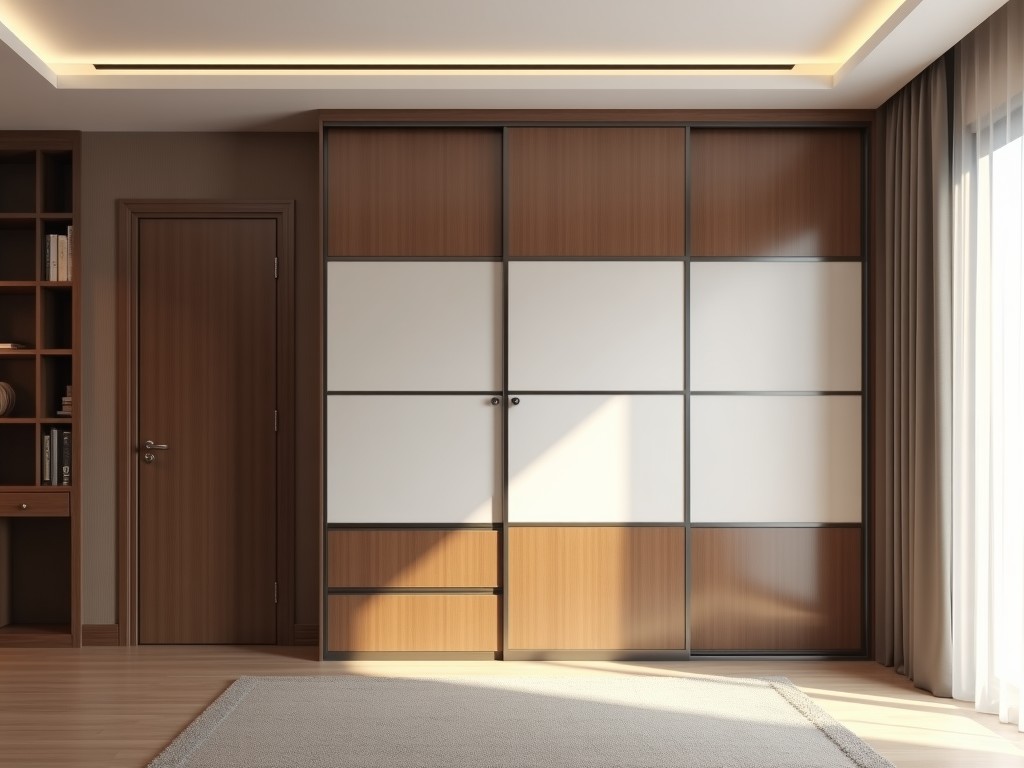
Oem Custom Sliding Door Wardrobe
Inquire Now
OEM Custom Sliding Door Wardrobe
Sliding door wardrobes provide space‑saving storage where swing doors are impractical. In an OEM context, the system is engineered to meet specific dimensional, load, and finish requirements of the end‑product, allowing seamless integration into cabinetry, built‑in furniture, or modular room systems.
Material Options
Common structural materials include extruded aluminum alloy (6063‑T5) with wall thicknesses ranging from 1.2 mm to 2.0 mm, cold‑rolled steel sheets (SPCC) treated with zinc‑phosphate coating, and high‑density particleboard or MDF panels faced with melamine, veneer, or laminate finishes. Material selection influences weight, corrosion resistance, and surface durability.
Design Considerations
The sliding mechanism typically employs a bottom‑guided roller system or a top‑hung track with anti‑derailment guides. Load capacity per door leaf is calculated based on roller bearing rating, track deflection limits, and panel weight, often specified as 60 kg to 100 kg for residential applications. Track straightness tolerance is maintained within ±0.2 mm over the full length to ensure smooth, quiet operation.
Customization Choices
- Panel width: 400 mm to 1200 mm per leaf, height up to 2600 mm
- Track type: surface‑mounted, recessed, or concealed within soffit
- Hardware finish: brushed aluminum, powder‑coat (RAL colors), stainless steel, or black oxide
- Door infill: mirrored glass, tempered glass, perforated metal, or acoustic panel
- Accessories: soft‑close dampers, push‑to‑open mechanisms, integrated lighting profiles
Manufacturing Process
Production begins with CNC cutting of panels to exact dimensions, followed by edge banding or lamination as specified. Extruded aluminum tracks are cut, deburred, and pre‑drilled for roller brackets. Assembly involves inserting rollers, aligning guides, and applying torque‑controlled fasteners to prevent track distortion. Each unit undergoes a functional test cycle of 500 open‑close operations to verify smooth motion and noise levels below 45 dB(A).
Quality Control Philosophy
Inspection points include material thickness verification (±0.05 mm), surface finish adhesion (cross‑hatch test per ASTM D3359), roller rotation smoothness (measure of starting torque <0.2 Nm), and overall door alignment (vertical deviation <1.5 mm). Statistical process control tracks key dimensions across batches, with a target Cp ≥ 1.33 for critical features.
Typical Applications
Sliding door wardrobes are selected in environments where floor clearance is limited, such as hospital patient rooms, hotel guest suites, and high‑density residential apartments. The low‑profile track reduces tripping hazards, while the ability to integrate lighting or acoustic panels adds functional value beyond simple storage.
Specification Table
| Parameter | Typical Value / Range |
|---|---|
| Panel Thickness | 16 mm – 25 mm (depending on infill) |
| Door Leaf Weight Capacity | 60 kg – 100 kg per leaf |
| Track Material | Extruded Aluminum 6063‑T5 or Cold‑rolled Steel |
| Roller Type | Polyoxymethylene (POM) wheel with sealed ball bearing |
| Finish Options | Brushed Anodized, Powder‑coat (RAL), Laminate, Veneer, Mirror |
| Maximum Height | 2600 mm (standard), custom up to 3200 mm on request |
| Lead Time (Tooling Included) | 4–6 weeks after drawing approval |
Frequently Asked Questions
- Q: Can the door dimensions be customized to fit non‑standard openings?
A: Yes, width and height are adjustable within the structural limits of the selected track and panel material; custom sizes require engineering review. - Q: What information is needed to provide a quotation?
A: Required inputs include opening width, height, desired panel infill, track mounting preference, finish specifications, and quantity. - Q: Which materials are available for the door panels?
A: Options range from melamine‑faced particleboard, MDF, plywood, to tempered glass, mirrored glass, and perforated metal, each with defined thickness and weight characteristics. - Q: How is quality inspected before shipment?
A: Each unit undergoes dimensional verification, functional slide testing, and surface finish audit; a test report is available upon request. - Q: What packaging methods protect the product during export?
A: Panels are packed in flat‑pack corrugated boxes with corner protectors; tracks and hardware are sealed in moisture‑barrier bags and placed in the same carton to prevent loss. - Q: What is the typical production lead time?
A: After final drawing approval, standard lead time is 4–6 weeks; expedited schedules can be discussed based on tooling availability.
Get Started
To discuss your specific sliding door wardrobe requirements, provide your project drawings or functional specifications, and our engineering team will return a detailed feasibility review and cost estimate.
Related Products
Related News

custom closet spatial organization and material performance analysis

Bathroom Taps Technical Analysis
