
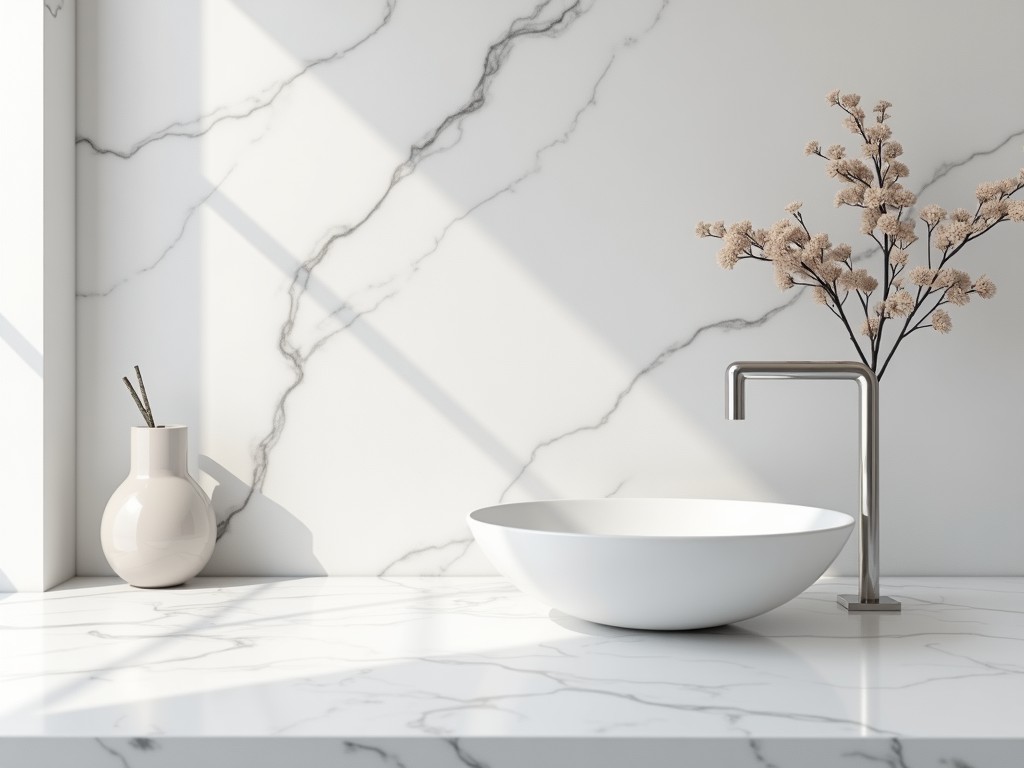
Quartz Countertops White With Grey Veins
Inquire Now
White Quartz Countertop with Grey Veining
This engineered stone consists of approximately 93% natural quartz aggregate bound by 7% polymer resin and pigment additives. Standard slabs measure 3200 mm × 1600 mm with thickness options of 20 mm or 30 mm, providing a seamless surface for large installations.
Material Composition
The quartz crystals supply hardness and dimensional stability, while the resin matrix imparts flexibility and impact resistance. Pigments are dispersed uniformly to achieve the white base, and grey veining is created through a controlled digital inkjet process that mimics natural stone patterns.
Resin content is carefully calibrated to maintain a non‑porous surface, preventing liquid ingress and facilitating easy cleaning.
Mechanical Properties
Mohs hardness of 7 ensures resistance to scratching from typical kitchen utensils. Flexural strength averages 50 MPa, allowing the slab to span standard cabinet overhangs without additional support.
Water absorption is below 0.05% by weight, which virtually eliminates staining from common substances such as wine, oil, and acidic foods. The material tolerates brief exposure to temperatures up to 150 °C; prolonged direct heat should be avoided to prevent resin degradation.
Compressive strength exceeds 200 MPa, providing durability under heavy loads typical in laboratory workstations.
Aesthetic Characteristics
The veining appears as subtle, linear grey streaks that vary in width from 0.5 mm to 2 mm, distributed across the slab to emulate marble‑like movement. Color consistency is monitored with a ΔE tolerance of less than 2 units between production batches.
Surface finish options influence light reflectance: a polished finish yields a specular gloss of 70‑80 GU, while a honed finish reduces glare to 20‑30 GU, suitable for environments where reflective glare is undesirable.
Applications
In laboratory settings, the non‑porous surface resists chemical spills and simplifies decontamination protocols, reducing cross‑contamination risk. The material’s dimensional stability ensures that precision equipment remains level over time.
Healthcare facilities benefit from the seamless joints that eliminate crevices where pathogens can harbor, supporting infection‑control standards. The low maintenance requirement translates to lower lifecycle costs compared with natural stone.
Hospitality venues select this countertop for its ability to withstand high traffic, resist impact from dropped items, and maintain appearance despite frequent cleaning cycles.
Technical Specifications
| Property | Typical Value | Test Method |
|---|---|---|
| Density | 2.3 g/cm³ | ASTM C97 |
| Flexural Strength | 50 MPa | ASTM C880 |
| Compressive Strength | 200 MPa | ASTM C170 |
| Water Absorption | <0.05% | ASTM C97 |
| Mohs Hardness | 7 | EN 101 |
| Heat Resistance (short term) | 150 °C | Manufacturer internal |
| Stain Resistance (rating) | Class 5 (no visible stain) | ANSI/SSINA |
Quality Control
Each slab undergoes thickness verification with a tolerance of ±0.5 mm across the entire panel. Color consistency is checked using a spectrophotometer, ensuring ΔE < 2 between the target white and produced sample.
Veining alignment is inspected visually under standardized lighting to confirm that the grey streaks follow the intended direction and density. Surface flatness is measured with a straightedge and feeler gauge, accepting deviations under 0.3 mm over a 1‑meter span.
Gloss levels are quantified with a glossmeter; polished finishes must read between 65‑80 GU, honed finishes between 18‑28 GU. Any slab failing these criteria is re‑processed or rejected.
Customization Options
- Edge profiles: eased, bevel, bullnose, ogee, waterfall.
- Thickness: 20 mm (standard) or 30 mm for heavy‑duty applications.
- Slab dimensions: up to 3200 mm × 1600 mm; custom lengths available upon request.
- Veining intensity: low (subtle), medium (balanced), high (pronounced).
- Finish: polished, honed, leathered, or brushed.
Frequently Asked Questions
Can dimensions be customized?
Yes. Slabs can be cut to specific lengths and widths, and edge profiles can be tailored to project requirements.
What information is required before quotation?
Project dimensions, desired thickness, edge profile, finish, and any special veining intensity preferences.
Are samples available?
Small sample tiles (100 mm × 100 mm) can be shipped for visual and tactile evaluation; shipping charges apply.
How is quality inspected?
Thickness, color ΔE, veining alignment, flatness, and gloss are measured against internal specifications before packaging.
What packaging methods protect the slabs?
Slabs are separated by polyethylene foam, placed on wooden pallets, and secured with steel straps; corner protectors prevent edge damage.
Next Steps
To discuss your specific requirements, request a detailed quotation, or arrange a sample shipment, please contact our technical sales team.
Related Products
Related News

custom closet spatial organization and material performance analysis

Bathroom Taps Technical Analysis
