
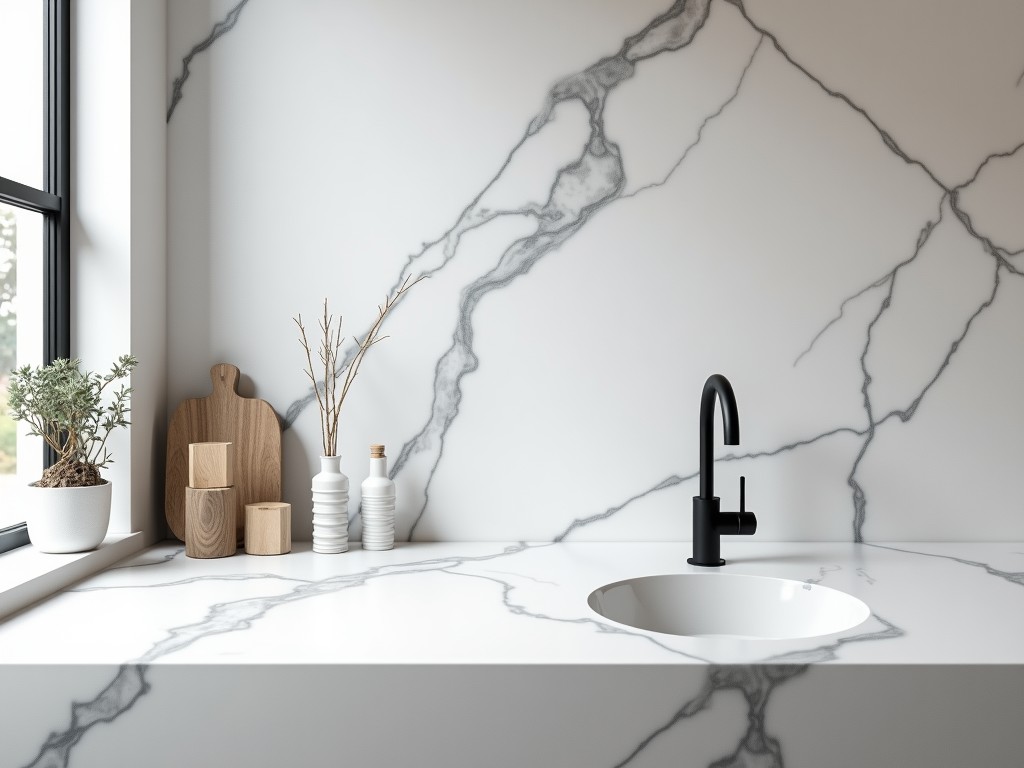
White And Gray Quartz Countertops With Grey Veins
Inquire Now
White and Gray Quartz Countertops with Grey Veins
These slabs combine a predominantly white‑gray matrix with dispersed grey veining that mimics natural stone while delivering the consistency required for industrial fabrication.
The base material is engineered quartz, consisting of approximately 90–95% ground quartz aggregate bound by polymer resins and pigments.
Veins are introduced through controlled dispersion of grey‑toned pigment slurry during mixing, resulting in veining patterns that range from fine hairlines to broader bands depending on slurry flow rate and curing temperature.
Typical slab dimensions are 3050 mm × 1440 mm with thicknesses of 20 mm, 30 mm, or 40 mm, allowing flexibility for edge‑built countertops, island tops, and wall cladding.
| Property | Typical Value | Test Method |
|---|---|---|
| Compressive Strength | ≥ 150 MPa | ASTM C170 |
| Flexural Strength | ≥ 50 MPa | ASTM C99 |
| Water Absorption | ≤ 0.02 % | ASTM C97 |
| Hardness (Mohs) | 6–7 | ISO 10545‑12 |
| Thermal Expansion Coefficient | 25 × 10⁻⁶ / °C | ASTM E228 |
The production line begins with quartz crushing to a defined particle size distribution (0.1–0.5 mm) to ensure optimal packing density. The aggregate is blended with a proprietary unsaturated polyester resin system, pigments, and a coupling agent under vacuum to eliminate entrapped air.
Veining is achieved by injecting a grey‑pigmented resin slurry into the moving slab via precision nozzles; the slurry’s viscosity and flow rate are adjusted in real time to obtain the desired vein width and spacing.
After mixing, the material is vibro‑compacted in a mold, then cured in a controlled‑temperature oven (typically 80–100 °C for 60–90 minutes) to achieve full polymer cross‑linking.
Slabs are subsequently calibrated to thickness tolerance of ±0.1 mm and polished using a sequence of diamond abrasives ranging from 50 grit to 3000 grit to obtain a gloss level above 80 GU.
Each slab undergoes dimensional inspection using laser scanning to verify length, width, and thickness within tolerance. Surface quality is assessed by automated vision systems that detect pits, scratches, or color deviations exceeding ΔE > 2.0.
Veining consistency is evaluated by comparing vein intensity distribution against a reference image set; batches with >15 % variance are reworked.
Final quality documentation includes a test certificate reporting compressive strength, flexural strength, water absorption, and a slip‑resistance rating (when applicable) according to ANSI A137.1.
Typical industrial and commercial applications where the combination of high durability and aesthetic veining adds value:
- Laboratory countertops requiring chemical resistance and low porosity.
- Food‑processing work surfaces where seamless joints prevent bacterial harborage.
- Retail display tops that benefit from a premium stone look without the variability of natural granite.
- Hospitality reception desks where impact resistance reduces chipping risk.
- Wall cladding in high‑traffic corridors where ease of cleaning and stain resistance are critical.
Beyond the standard white‑gray base with grey veins, the product line supports:
- Adjustable vein density (low, medium, high) by altering slurry injection frequency.
- Custom pigment blends to shift the base tone toward warmer ivory or cooler silver.
- Edge profiles including eased, beveled, ogee, and waterfall, machined to ±0.2 mm tolerance.
- Thickness options of 12 mm, 15 mm, 20 mm, 30 mm, and 40 mm for specific load‑bearing requirements.
Proper installation ensures long‑term performance:
- Use a flexible, polymer‑modified thin‑set mortar with a minimum bond strength of 1.5 MPa to accommodate minor substrate movement.
- Maintain a minimum 2 mm expansion gap at perimeters, filled with a neutral‑cure silicone sealant.
- Seal cut edges with a penetrating quartz sealer if the surface will be exposed to oils or acidic substances.
- Allow the adhesive to cure for 24 hours before applying any load.
Routine care involves:
- Cleaning with pH‑neutral detergent and a soft cloth; avoid abrasive pads that could reduce gloss.
- Immediate wipe‑up of spills, especially acidic liquids like vinegar or citrus juice, to prevent potential resin etching.
- Periodic re‑application of a quartz‑specific polish every 12–18 months to restore factory gloss if desired.
Frequently Asked Questions
- Can dimensions be customized beyond standard slab sizes?
- Yes. Slabs can be cut to specific lengths and widths using CNC waterjet or bridge saws; edge finishing is performed post‑cut to maintain tolerances.
- What information is required for a quotation?
- Project specifications including slab thickness, edge profile, vein density preference, total square footage, and any required cut‑outs (sink, cooktop) enable accurate pricing and lead‑time estimation.
- How is veining consistency assured across multiple slabs?
- Each batch is monitored with inline spectrophotometers; vein intensity is logged and compared to a master reference. Slabs falling outside the defined variance window are segregated for reprocessing.
- What is the typical production lead time?
- Lead time varies with order size and customization; standard stock slabs ship within 5–7 business days, while customized runs typically require 10–15 business days.
Related Products
Related News

custom closet spatial organization and material performance analysis

Bathroom Taps Technical Analysis
