
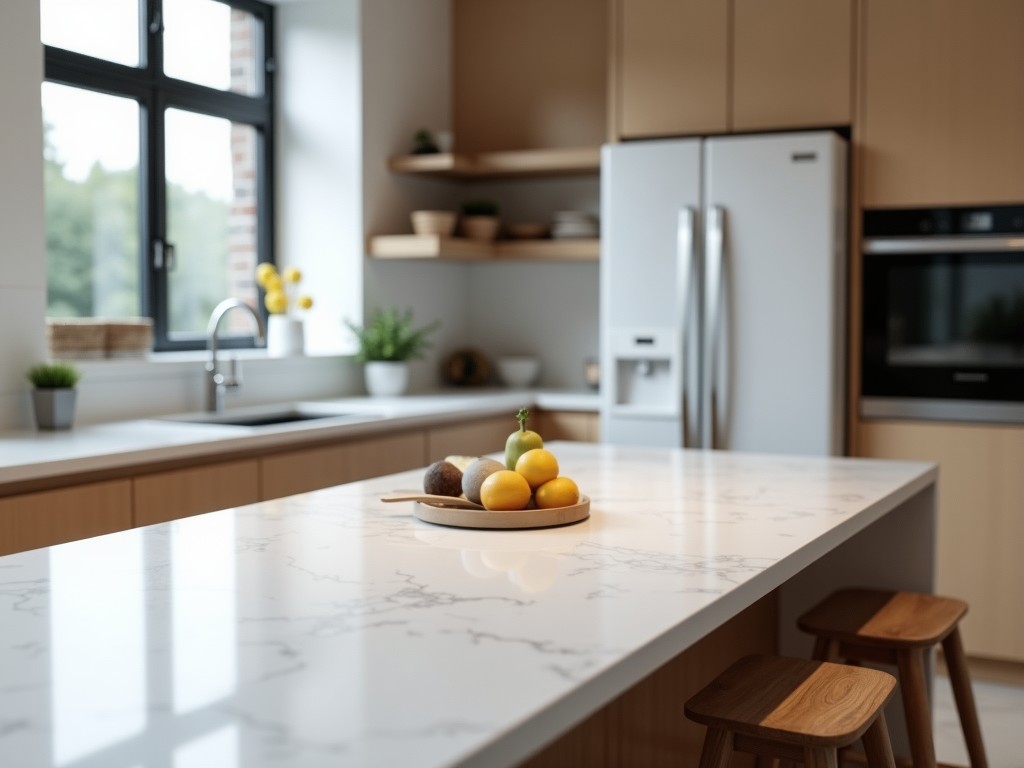
White Quartz Kitchen Countertops Price Cost
Inquire Now
White Quartz Kitchen Countertops: Price and Cost Considerations
White quartz countertops combine the visual appeal of natural stone with the consistency of an engineered surface, making them a common choice for commercial kitchen installations where durability and hygiene are priorities.
Material Composition and Performance
The core of white quartz surfaces consists of approximately 90‑95 % ground quartz aggregate bound by polymer resins and pigments, resulting in a non‑porous slab that resists liquid absorption and staining.
Typical flexural strength exceeds 40 MPa, and Mohs hardness registers around 7, providing resistance to scratches from cutlery and light impacts encountered in food‑service environments.
Manufacturing Process for Consistent Quality
Production begins with careful selection of raw quartz crystals, which are washed, graded, and mixed with resin under vacuum to eliminate air bubbles.
The mixture is then vibro‑compacted into slabs, cured in a controlled temperature cycle, and polished to achieve the specified gloss level, ensuring uniform thickness and surface finish across large production runs.
Factors Influencing Price
Several variables determine the final cost of quartz countertops, including slab thickness, edge profile, surface finish, and any custom cut‑outs for sinks or appliances.
Transportation distance and project‑specific installation requirements also affect the overall quotation, particularly for large‑scale commercial kitchens.
Typical Price Ranges
| Thickness (mm) | Edge Profile | Price Range (USD/ft²) |
|---|---|---|
| 20 | Eased | 55 – 70 |
| 20 | Bullnose | 65 – 85 |
| 30 | Eased | 70 – 90 |
| 30 | Ogee | 85 – 110 |
Customization Options Affecting Cost
Beyond slab dimensions, specific finishes such as honed, polished, or leathered alter the price due to additional processing steps.
Edge treatments ranging from simple eased to complex waterfall or laminated edges increase labor and material usage, which is reflected in the unit cost.
Cut‑outs for undermount sinks, cooktops, or drainage grooves require CNC machining, adding a per‑opening charge that varies with geometry complexity.
Quality Control and Testing
Each slab undergoes systematic inspection to verify dimensional accuracy, thickness tolerance (±0.5 mm), and surface defect limits.
Resin cure quality is assessed via barcol hardness testing, while chemical resistance is checked using standardized exposure to common food acids and cleaning agents.
Slabs that fail any criterion are reworked or rejected, ensuring that only material meeting the specified performance metrics reaches the customer.
Applications in Commercial Kitchens
In food‑service environments, quartz countertops resist staining from oils, sauces, and acidic substances, reducing the risk of bacterial harborage in surface pores.
Their non‑porous nature also simplifies cleaning regimens, allowing compliance with health‑code standards without the need for periodic sealing.
The material’s thermal stability tolerates brief exposure to hot pans, although sustained direct heat should be mitigated with trivets to protect the resin binder.
Frequently Asked Questions
Q: Can dimensions be customized to fit irregular kitchen layouts?
A: Yes, slabs can be cut to precise lengths and widths using CNC equipment; detailed shop drawings are required before production.
Q: What information is needed to obtain an accurate quotation?
A: Provide slab thickness, edge profile, finish type, total square footage, and any cut‑out specifications; a site plan helps assess logistics.
Q: Are there limitations on overhang lengths for unsupported sections?
A: Overhangs exceeding 250 mm typically require additional support brackets or corbels to prevent sagging under load.
Request a detailed quotationRelated Products
Related News

custom closet spatial organization and material performance analysis

Bathroom Taps Technical Analysis
