
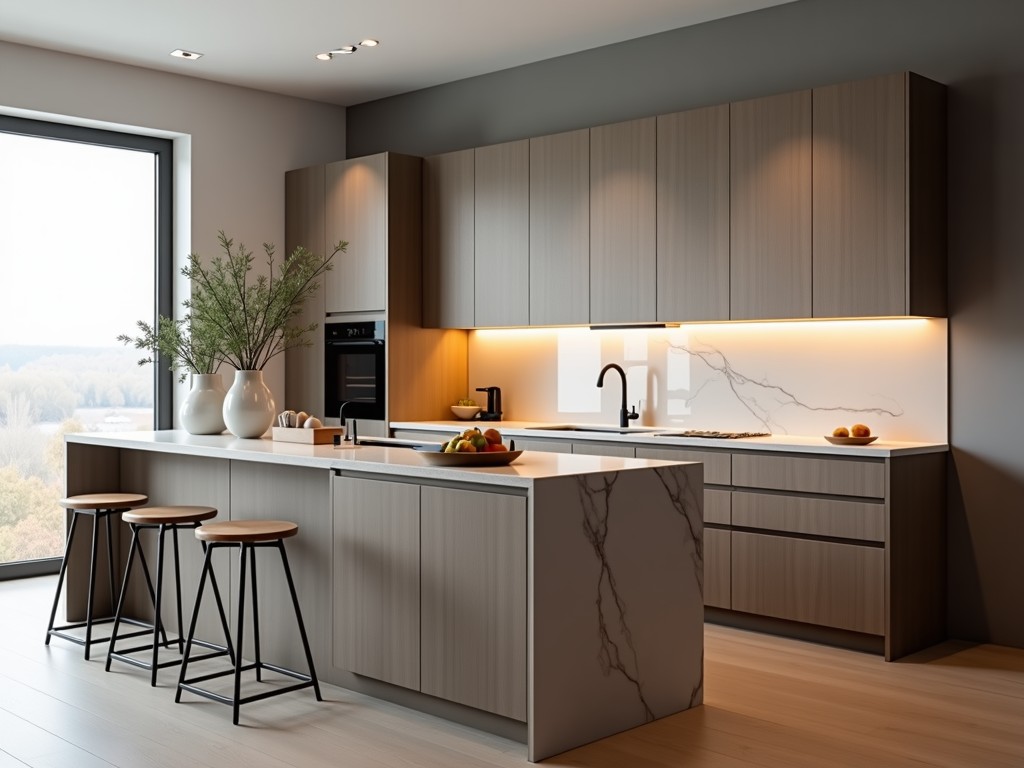
Wholesale Custom Modern Kitchen Cabinets
Inquire Now
Wholesale Custom Modern Kitchen Cabinets
Modern kitchen cabinets for wholesale projects are engineered to meet strict dimensional tolerances while accommodating diverse design languages. The core structure typically employs 18 mm engineered plywood or particleboard cores, selected for their consistent modulus of elasticity and resistance to warping under humidity fluctuations typical in commercial kitchens.
Panel edges are sealed with 0.5 mm PVC or melamine edge banding, applied via hot‑melt adhesive to achieve a bond strength exceeding 1.2 MPa, which prevents delamination during repeated cleaning cycles. This edge treatment also contributes to a seamless visual line when cabinets are aligned in continuous runs.
Material Selection
Core materials are chosen based on project‑specific load requirements and environmental exposure. For high‑traffic service areas, 19 mm marine‑grade plywood with a face veneer of hardwood (e.g., maple, birch) provides a bending strength of approximately 45 MPa, sufficient to support countertop loads up to 150 kg per linear meter without noticeable deflection.
In budget‑sensitive installations, 16 mm low‑emission particleboard meets CARB Phase 2 formaldehyde limits (<0.05 ppm) and offers a uniform density of 650 kg/m³, facilitating consistent CNC machining tolerances of ±0.2 mm across large production runs.
Construction Methods
Cabinet boxes are assembled using dado joints reinforced with 6 mm dowels and polyvinyl acetate (PVA) adhesive, delivering shear strength values around 2.8 MPa. This joint configuration resists racking forces encountered during installation and subsequent appliance loading.
Face frames, when specified, are constructed from solid hardwood strips (typically 19 mm × 45 mm) mortised and tenoned into the box, providing additional stiffness that reduces lateral drift by up to 30 % compared to frameless designs under identical load conditions.
Customization Options
- Door overlay: full overlay, half overlay, or inset, each affecting the required clearance for hinge selection and overall kitchen ergonomics.
- Panel thickness: ranging from 16 mm to 22 mm, adjustable to meet specific acoustic or fire‑rating criteria.
- Interior accessories: pull‑out shelves, blind corner units, and integrated lighting channels, all designed to standard 32 mm module spacing for seamless retrofitting.
Surface Finishes
Finishes are applied in a controlled spray booth with a target film thickness of 60 µm ±5 µm, measured via dry‑film thickness gauge. Available options include:
- Matte polyurethane (gloss <10 Units) offering abrasion resistance of 150 cycles (Taber CS‑17) before noticeable wear.
- Semi‑matt acrylic lacquer (gloss 30‑40 Units) with UV stabilizers limiting color shift to ΔE<2 after 200 hours of accelerated weathering.
- High‑gloss polyester (gloss >80 Units) providing a surface hardness of 2H (pencil test) suitable for environments requiring frequent sanitization.
Hardware Integration
Concealed hinges are selected based on door weight and opening angle; typical specifications include a 110° opening angle, 3‑point adjustment (±1.5 mm depth, ±1 mm side, ±0.5 mm height) and a load rating of 25 kg per hinge pair. Soft‑close dampers are calibrated to provide a closing speed of 0.2 m/s, reducing impact force by approximately 40 % compared to non‑damped hinges.
Drawer systems employ full‑extension ball‑bearing slides with a dynamic load capacity of 40 kg and a side‑play tolerance of ≤0.15 mm, ensuring smooth operation even when subjected to repeated lateral forces from heavy cookware.
Manufacturing Tolerances and Quality Control
CNC cutting maintains a positional accuracy of ±0.1 mm, verified through laser measurement on each batch. Edge banding alignment is inspected using a vision system that flags deviations greater than 0.2 mm, triggering automatic rework.
Finished cabinets undergo a functional test cycle: doors are opened and closed 5,000 times, drawers are extended and retracted 3,000 times, and all hardware is torque‑checked to manufacturer specifications. Units that exceed a 2 % failure rate in any test are segregated for further analysis.
Applications in Commercial Kitchens
The modular nature of these cabinets allows rapid reconfiguration of line layouts, a critical factor for food‑service operations that frequently update menus or equipment. Standard 600 mm width modules align with common appliance footprints, minimizing custom filler work and reducing on‑site installation time by an estimated 15‑20 % compared to bespoke built‑in solutions.
Moisture‑resistant core materials and sealed edges meet the hygiene standards required in HACCP‑compliant environments, facilitating easy cleaning with neutral pH detergents without risk of substrate swelling or delamination.
Typical Specifications
| Parameter | Typical Value | Customizable Range |
|---|---|---|
| Core Material | 18 mm Engineered Plywood | 16‑22 mm Plywood, Particleboard, MDF |
| Door Thickness | 19 mm | 16‑25 mm |
| Overlay Type | Full Overlay | Half Overlay, Inset |
| Edge Banding | 0.5 mm PVC | 0.5‑2 mm ABS, Melamine, Wood Veneer |
| Finish Gloss | Matte (≤10 GU) | Matte, Semi‑Matt, High‑Gloss |
| Hinge Load Rating | 25 kg per pair | 15‑40 kg per pair |
| Drawer Slide Capacity | 40 kg | 20‑60 kg |
Frequently Asked Questions
Yes. All panels are produced to customer‑supplied CAD files or detailed drawings. Tolerances are held to ±0.2 mm for length and width, and ±0.1 mm for thickness, ensuring seamless integration with adjacent elements such as walls, soffits, and appliances.
A quotation requires: (1) overall kitchen layout or module schedule, (2) selected core material and finish, (3) door style and overlay preference, (4) hardware specifications (hinge type, slide rating), and (5) any required certifications (e.g., CARB, FSC). Providing these details enables an accurate material take‑off and lead‑time estimate.
Quality control includes in‑process checks: CNC dimensional verification, edge‑banding adhesion testing (peel strength >1.2 MPa), finish thickness measurement, and functional hardware testing. Final audit consists of a 5,000‑cycle door operation test and a 3,000‑cycle drawer test, with acceptance criteria based on zero functional defects.
Related Products
Related News

custom closet spatial organization and material performance analysis

Bathroom Taps Technical Analysis
