
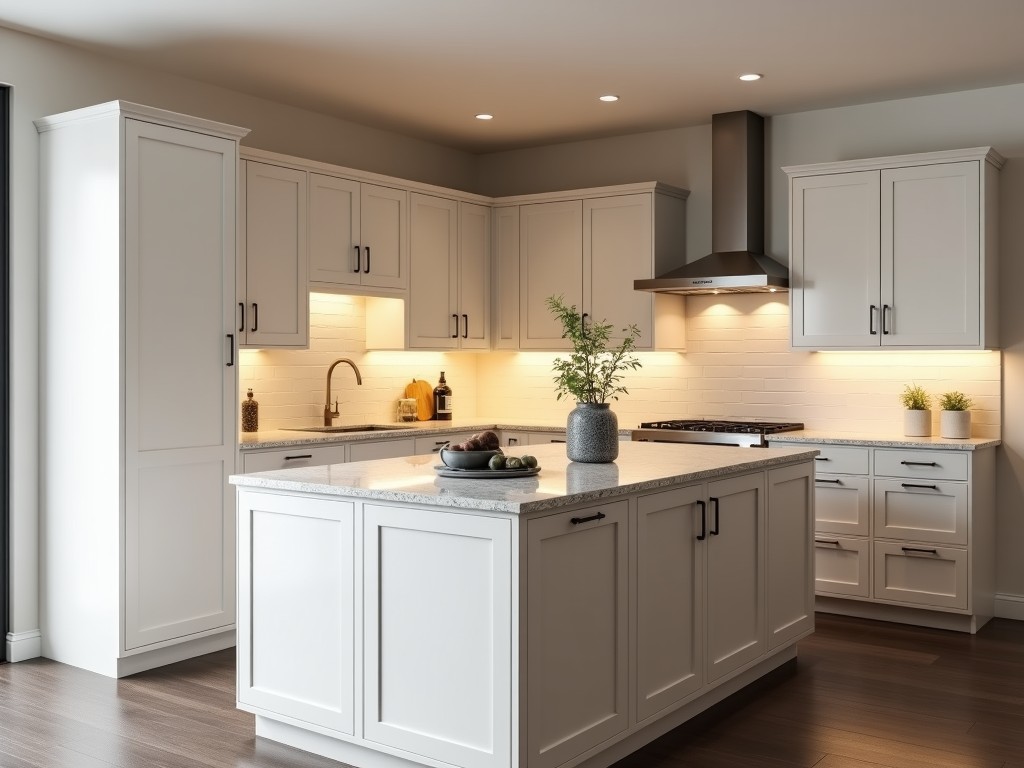
Wholesale Custom Shaker Kitchen Cabinets
Inquire Now
Wholesale Custom Shaker Kitchen Cabinets
Shaker-style doors consist of a flat central panel surrounded by a uniform frame, which reduces stress risers and allows predictable deflection under load. The geometry simplifies machining because all edges are straight and can be processed with standard CNC routers. Wholesale ordering enables consistent grain orientation and moisture content across large batches, minimizing dimensional drift after installation.
Material Selection and Structural Characteristics
Core materials typically include hardwood plywood (birch or maple faces, 18 mm thickness) with a modulus of rupture exceeding 70 MPa, or medium-density fiberboard (MDF) with a density of 720 kg/m³ and a thickness tolerance of ±0.3 mm. Solid wood options such as hard maple provide a specific gravity of 0.65 and a shrinkage rate of 4 % tangential, 2 % radial when acclimated to 8 % ± 2 % relative humidity. These values allow designers to calculate deflection limits for countertop overhangs.
Dimensional Customization and Joinery
Cabinet boxes are built to specified width, height, and depth with a tolerance of ±0.5 mm on all linear dimensions, ensuring alignment with modular countertop systems. Joinery methods include dados and rabbets for shelf support, reinforced with 8 mm dowels or pocket screws delivering shear strengths above 2 kN per joint. Adjustable concealed hinges are mounted using 35 mm cup holes positioned with a positional tolerance of ±0.2 mm.
Finish and Surface Treatment
Finishes are applied as UV‑cured polyurethane films with a dry thickness of 40–60 µm, providing a pencil hardness of 2H–3H and a VOC content below 50 g/L. Water‑based lacquer alternatives achieve a thickness of 35 µm and a gloss level of 85 ± 5 GU at 60°. Edge banding uses PVC or ABS strips with a thickness of 0.8 mm, bonded with hot‑melt adhesive delivering peel resistance > 1.5 N/mm.
Manufacturing Process Overview
Panels are cut on 5‑axis CNC routers to ±0.1 mm positional accuracy, followed by automatic edge banding machines that apply glue at 180 °C and pressure of 2 bar. Holes for hinges and shelf pins are drilled using multi‑spindle heads with a cycle time of 1.2 s per panel. Assembly occurs on pneumatic clamping fixtures that maintain 90 ° angles within ±0.3 °, after which the sub‑assembly undergoes a 30‑second UV cure cycle.
Quality Control and Testing
Each cabinet undergoes a dimensional check using laser scanners that compare the scanned point cloud to the CAD model, flagging deviations > 0.4 mm. Adhesion of the finish is measured by cross‑hatch tape test according to ASTM D3359, requiring a rating of 5B. Load testing applies a 150 N vertical force to the door panel for 10 cycles, with acceptable deflection limited to 2 mm. Final inspection includes a visual assessment for color uniformity under D65 lighting, with ΔE < 2 considered acceptable.
Applications in Commercial and Residential Projects
The Shaker profile’s flat surfaces facilitate easy cleaning, a critical requirement in healthcare and food‑service environments where biofilm accumulation must be minimized. Its simple geometry allows seamless integration with full‑overlay hinges, enabling a consistent reveal of 2 mm across adjacent units. In residential settings, the reduced profile height lowers the cabinet’s center of gravity, improving stability when tall units are anchored to stud walls.
Material Performance Comparison
| Material | Density (kg/m³) | Modulus of Rupture (MPa) | Thickness Swell (% at 24 h immersion) | Typical Finish Compatibility |
|---|---|---|---|---|
| Hardwood Plywood (Birch) | 620 | 78 | 0.4 | UV PU, Water‑based Lacquer |
| MDF | 720 | 35 | 1.2 | Melamine, UV PU |
| Solid Hard Maple | 680 | 92 | 0.2 | Oil, UV PU, Lacquer |
Frequently Asked Questions
- Can dimensions be customized to match existing field measurements? Yes. Provide a DXF or DWG with required width, height, depth, and any cut‑outs; we will produce a first‑article sample for approval before batch production.
- What information is required before a quotation can be issued? Bill of materials showing material grade, panel thickness, finish type, hardware specifications, and total quantity. Edge‑banding color and hinge model are also needed for accurate costing.
- Which material options are available for high‑humidity environments? Marine‑grade plywood with phenol‑formaldehyde resin, or PVC‑laminated MDF, both exhibit thickness swell below 0.5 % after 24 h water immersion.
- How is quality inspected before shipment? Each lot undergoes dimensional laser scanning, finish adhesion testing, and a 10‑cycle load test as described in the QC section. A sample from each lot is retained for 90 days for potential audit.
- What packaging methods protect cabinets during overseas transport? Flat‑packed units are placed in double‑wall corrugated cartons with corner protectors, then strapped onto pallets and wrapped in 80 µm stretch film. For LCL shipments, each carton receives a moisture‑barrier bag.
- What is the typical production lead time for a standard order? Four to six weeks after receipt of approved drawings and material confirmation, assuming standard finish and hardware.
Request a Technical Quote
To begin the quotation process, submit your project drawings, material preferences, and hardware list. Our engineering team will review tolerances, generate a material take‑off, and return a detailed cost breakdown within two business days.
Request a QuoteRelated Products
Related News

custom closet spatial organization and material performance analysis

Bathroom Taps Technical Analysis
